Garage Door Off Track Repair in Niles, OH
A door that has left its track is propped up, coaxed back in and rehung on straight rail with sound rollers, and the cause is traced and corrected so it doesn't happen again.
Rollers free of the rail on a door in Niles, a town where the Mahoning River meets Mosquito Creek, a tilted or binding door, or a bowed panel at the catch point all mean off track. Don't use it or run the opener.
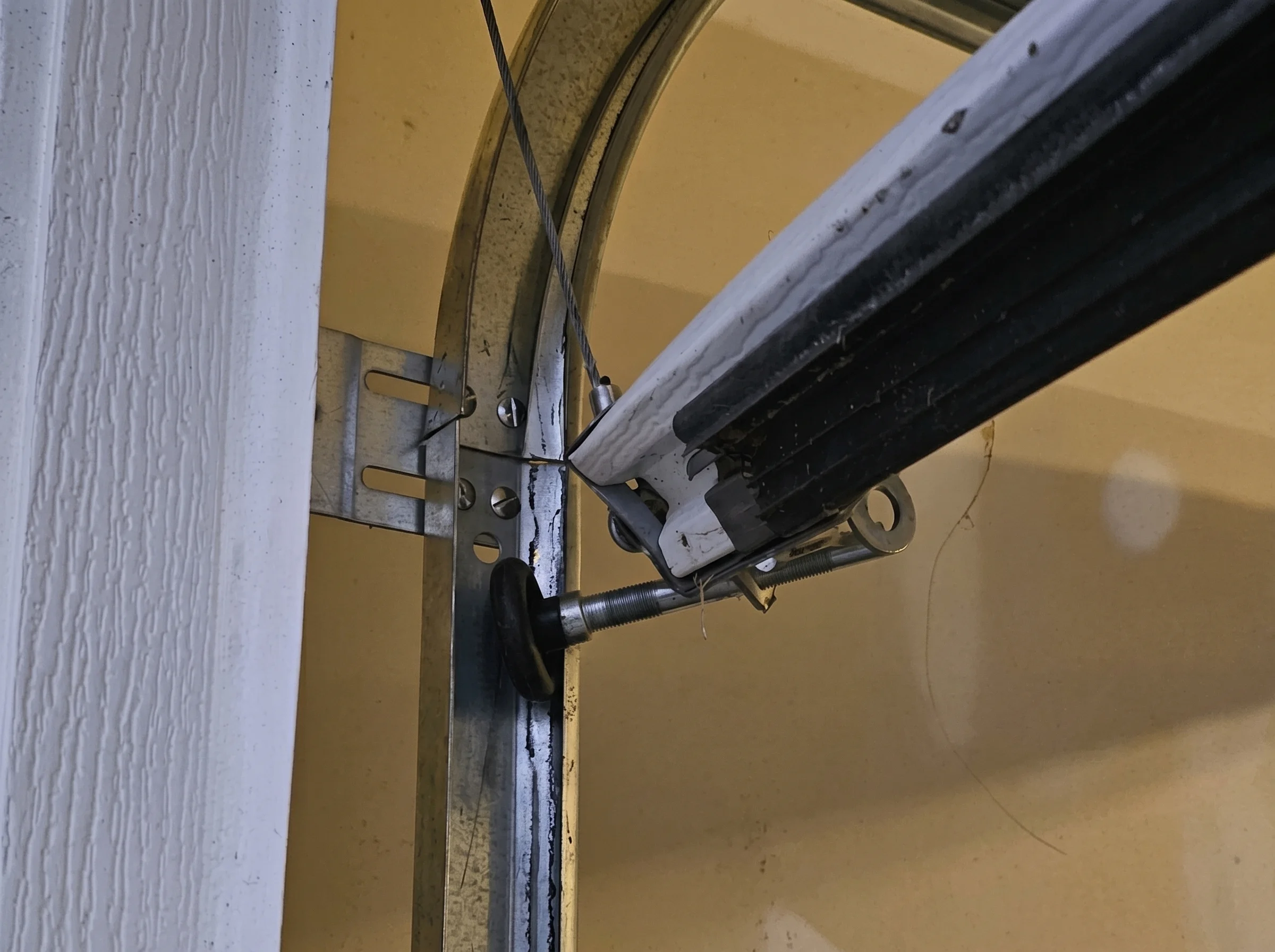
Signs the door is off its track
A roller hanging out beyond the rail, mostly near the floor or around the bend where the track turns up toward the garage ceiling.
The door stuck at a slant, frequently partway open.
A creased or bowed panel from the opener pushing on a jammed door for too long.
Rail bowed, dented or leaning away from the wall studs.
Scraping, popping or grinding just ahead of the moment it came loose.
Door has left the rails? Don't touch the opener. Note which side came out and what led up to it.
Contact UsHow a door ends up out of its rails
A bumper strike
Backing into a closed or half-open door tops the list, and it frequently bends the lower part of the track as well.
Cable broke or slid off
A corner drops, the door racks and rollers pop out. Cables get their own write-up under cable repair, covering that case in detail.
Rollers worn or broken
Once a roller bearing seizes, the wheel drags and then leaps out of the channel at the first rough spot.
Track bent or loose
Brackets holding the rail to the wall slacken from years of shaking, the gap opens up, and rollers escape through it.
Something under the door
A bike, mower or bin beneath a lowering door; the opener must reverse within 2 seconds, and high force undermines it.
Secure the area
Leave the opener off
The motor keeps shoving, which can crush panels or pull rail from the wall.
Don't yank the release cord when the door is part open and off track. It may fall, or swing completely clear of the rail.
Don't hammer the rollers back in under load. A derailed door still carries spring tension and can lurch suddenly and without any warning at all.
Keep your distance, and if a vehicle is shut in, include that in your first message.
What the fix involves
The door is propped and locked so it can't fall or shift during the work, and spring tension is managed where needed.
Damage is sized up
Which wheels, how many feet of rail, any panels creased, and what set it off: a cable, a spring or a knock.
Rail is trued or replaced
Small bends can be coaxed straight; kinked lengths get replaced.
Worn or broken rollers are swapped, and hinges are checked too, since a split hinge can throw a roller out again.
The door goes back on its rails, track brackets get tightened, and the door runs through complete cycles on the opener before force and travel limits are checked again.
Describe the door's behavior
One or two sentences get the conversation going. Knowing the failing part's name is unnecessary.
Rollers
Rollers set how quiet and smooth the ride is, and they wear out long before the door itself does, usually.
Bare steel wheels without bearings are the basic type. They rattle, and they scrape the rail as they travel.
Sealed-bearing nylon rollers glide almost silently and ask for hardly any lubricant.
Rollers are finished once they wobble, show flat spots, crack or seize on their bearings.
If the door only roars and hasn't actually failed, new rollers are often most of the cure, typically done on a maintenance visit as opposed to an emergency.
Cost drivers for off-track repair
How far it came out
A couple of rollers out at one corner, or the door swinging loose.
Rail damage
Straighten or replace, on one side or on both sides.
Rollers and hinges that need replacing.
Warped or cracked panels
A panel that bowed badly may have to be replaced, which can mean tracking down a match.
A failed cable or spring that triggered the derailment.
Panels too far gone to save
A badly hit door may have panels too bent to straighten. One panel can often be swapped if a match exists; ask the City of Niles Building Department if a permit applies to the work.
Where that isn't possible, or several panels took damage, garage door installation describes what replacement involves.
Quick answers
Is it safe to push the rollers back in myself?
Perhaps, when one bottom roller has slipped on a closed door and the rail is straight and every cable tight. For anything beyond that, hold off: the door is heavy, sprung and likely to shift when you least expect it.
Why does the same side keep derailing again?
Usually rail that has shifted slightly, a bracket that has worked loose, or a cable on that side set too slack or tight. Rehanging without finding the reason just invites a repeat.
Should the tracks get oil?
No. The rails stay clean and dry, since lubricant gathers grit. Bearings, hinges and springs are what get oiled, and little else.
More garage door help
Garage Door Spring Repair
Snapped torsion or extension springs exchanged for ones suited to how much the door weighs.
Read more →Garage Door Installation
New doors in steel, timber, composite or glass, built to your opening's dimensions.
Read more →Reach out
Tell us where the door sits (closed, open or midway), which side slipped out, whether something struck it, and whether a cable looks slack.
A photo of each side, taken from a few feet back, is the most useful thing you can pass along.